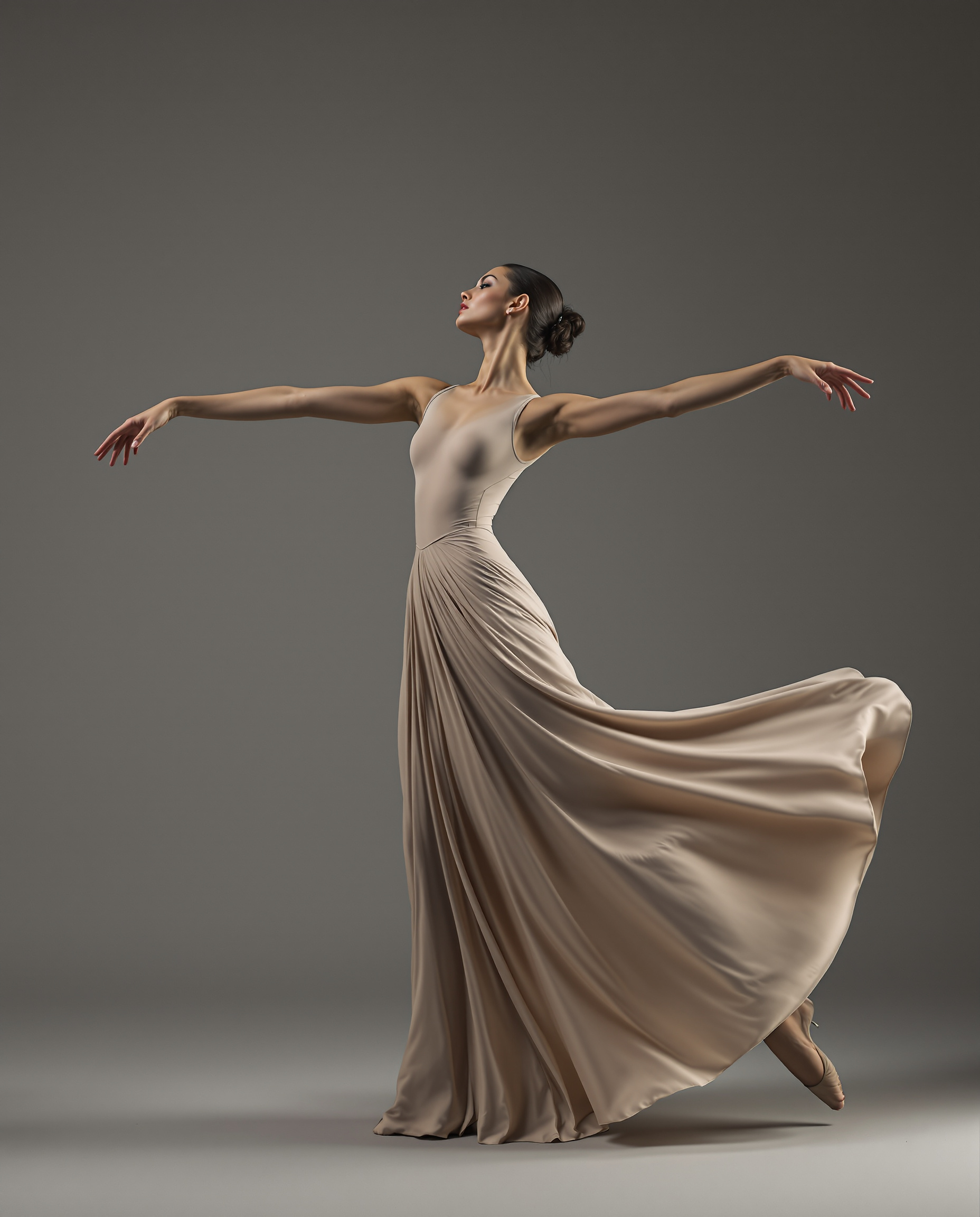
Posing & the Language of the Body
Posing is drawing with a person. A shift of weight, a turned wrist, a lengthened neck — these are the pencil strokes that turn a body into a line.
If light is the medium's raw material, pose is its grammar. The difference between an awkward frame and an elegant one is almost never the subject's appearance; it is the arrangement of forms in space. Good posing is a learnable craft built on a few durable principles.
Line and the long body
The eye reads elegance as length and curve. Photographers lengthen the neck, create separation between the arm and the torso, and look for the gentle S-curve that runs through a well-posed figure. Straight-on, symmetrical poses tend to flatten and widen; a slight turn of the shoulders and hips introduces depth and grace. The classical contrapposto of Greek sculpture — weight on one leg, hips and shoulders counter-rotated — remains the single most useful pose in the book, precisely because it has flattered the human form for two and a half thousand years.
Weight, tension, and the flattering angle
Where a subject places their weight changes everything. Shifting weight to the back foot, pressing gently into a wall, or lifting up and away from the camera all create tension and shape. A limb bearing no weight relaxes and reads as heavier; a limb under slight tension reads as toned and intentional. The camera's own position matters as much as the pose: shooting from slightly above tends to flatter, while a low angle lends power and monumentality — a choice explored further in lighting the figure, since angle and light must agree.
Hands, chin, and the small corrections
Hands betray tension faster than any other part of the body. The remedy is to give them something soft to do — resting lightly, grazing hair or fabric, never clenched or splayed flat toward the lens. The chin comes slightly forward and down to define the jaw. Shoulders drop away from the ears. These micro-corrections, applied kindly and quickly, are what clients experience as a photographer "knowing how to pose people."
Negative space and the frame
A pose does not end at the skin; it includes the space around it. Negative space — the emptiness a limb carves out, the gap between arm and waist — gives a figure room to breathe and reads as deliberate composition. Crowd those gaps and the body looks blocky; open them and it looks sculptural. This is where posing becomes composition, and composition becomes art.
Posing is best learned by studying sculpture and dance as much as photography. The figure collections of major museums, and the movement vocabulary of classical ballet, are inexhaustible references. When pose and light are working together, the next question is tone — which is why so many photographers reach for black and white.